
Monitoring & Managing
Proactive monitoring and management can help patients stay on track with OGSIVEO.
Supporting your patient’s journey on OGSIVEO
Patients can take an active part in their treatment by tracking changes to their symptoms as well as potential side effects during treatment.
Empower patients to be their own health advocates during treatment by providing them with tools and resources to track symptoms and potential side effects.
Encouraging open communication from treatment initiation can help you understand what your patients are experiencing and help you better support them throughout their journey on OGSIVEO.
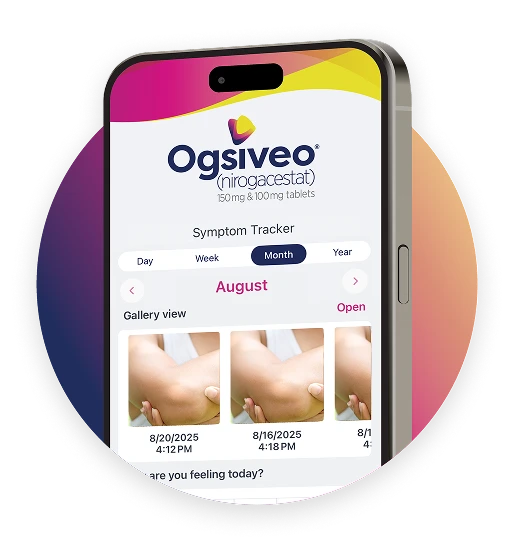
Symptom and side effect tracking with the OGSIVEO Digital Companion
Available through the free Medisafe app, patients can set up medication and refill reminders, log symptoms and potential side effects, and upload photos or scans of their tumor to help facilitate discussions with their care team.
Encourage patients to bring this information to their appointments.
Management strategies such as recommended dose modifications, medications, and lifestyle changes may help patients manage certain side effects of OGSIVEO if they arise.
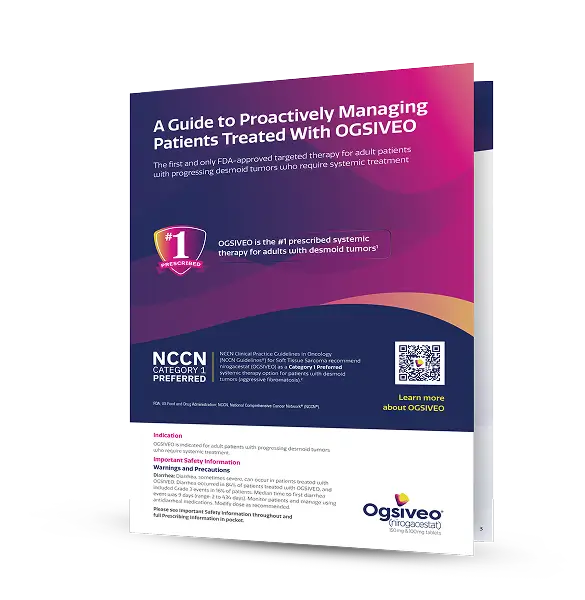
Our Side Effect Management Resource Guide can help you support your patients throughout their treatment journey.
Review practical strategies for helping patients stay on track with their therapy, including recommended dose modifications to help manage certain side effects.
In the OGSIVEO trial, 95% of adverse events were Grade 1 or 2 and first onset for most patients occurred within 1 month of starting OGSIVEO1
Dosage modifications for adverse reactions
Support your patients by proactively managing side effects and using dose modifications as recommended.
Recommended dose modifications for adverse reactions2
(≥3 to 5 x ULN)
For other severe adverse reactions, life-threatening adverse reactions, or persistent intolerable Grade 2 adverse reactions, withhold drug until resolved to Grade ≤1 or baseline. Only restart at a dosage of 100 mg twice daily after considering the potential benefit and likelihood of recurrence of the adverse reaction. Permanently discontinue OGSIVEO for recurrence of severe or life-threatening adverse reaction upon rechallenge at the reduced dose.
In patients who received OGSIVEO in the DeFi trial:
42% had dose reductions due to an adverse reaction2,*
51% had dose interruptions (median days interrupted per interruption: 8 days; range: 1 to 132 days) and 20% permanently discontinued due to an adverse reaction.2,3*
Adverse reactions that led to dose reduction, interruption, or discontinuation of OGSIVEO included: diarrhea, ovarian toxicity, increased ALT/AST, rash, stomatitis, hypophosphatemia, fatigue, folliculitis, nausea, and hidradenitis.2
For patients who were dose-reduced from 150 mg BID to 100 mg BID, no notable differences in PFS or ORR were observed3
Analysis Limitations
- Based on a post-hoc analysis comparing PFS and ORR in patients treated with OGSIVEO in the DeFi study who dose-reduced versus those who did not
- DeFi was not powered to assess statistical differences between subgroups and this analysis should be considered descriptive only
- Therefore, the results require cautious interpretation and could represent chance findings
- These data are not included in the OGSIVEO Prescribing Information
Medical interventions and lifestyle changes may also help manage certain side effects.
ALT, alanine aminotransferase; AST, aspartate aminotransferase; BID, twice daily; DeFi, Desmoid Fibromatosis; ORR, objective response rate; PFS, progression-free survival.
Patient Profiles
Review hypothetical patient profiles to learn about treatment considerations for different patient types. Setting expectations at treatment initiation, including discussing the most common adverse reactions with OGSIVEO and potential dose modifications may help patients stay on track with therapy.

Resources
Find information and resources to support your desmoid tumor patients, from diagnosis through treatment with OGSIVEO.

SpringWorks CareConnections® HCP Brochure
Learn about the SpringWorks CareConnections patient support program that provides personalized support to help your patients get started and stay on track with OGSIVEO.
