Monitoring & Managing

Proactive monitoring and management can help patients stay on track with OGSIVEO.

Supporting your patient’s journey on OGSIVEO

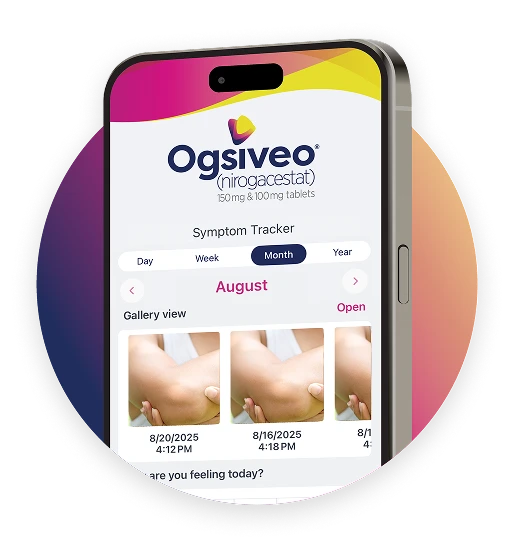
Patients can take an active part in their treatment by tracking changes to their symptoms as well as potential side effects during treatment.

Empower patients to be their own health advocates during treatment by providing them with tools and resources to track symptoms and potential side effects.

Encouraging open communication from treatment initiation can help you understand what your patients are experiencing and help you better support them throughout their journey on OGSIVEO.

Download the Treatment Tracker

The OGSIVEO treatment tracker can help patients monitor symptoms and log possible side effects, supplements, and care team recommendations all in one place.


Encourage patients to bring this tracker to their appointments.

OGSIVEO® (nirogacestat) treatment tracker PDF

Management strategies such as recommended dose modifications, medications, and lifestyle changes may help patients manage certain side effects of OGSIVEO if they arise.

Our Side Effect Management Resource Guide can help you support your patients throughout their treatment journey.

Review practical strategies for helping patients stay on track with their therapy, including recommended dose modifications to help manage certain side effects.
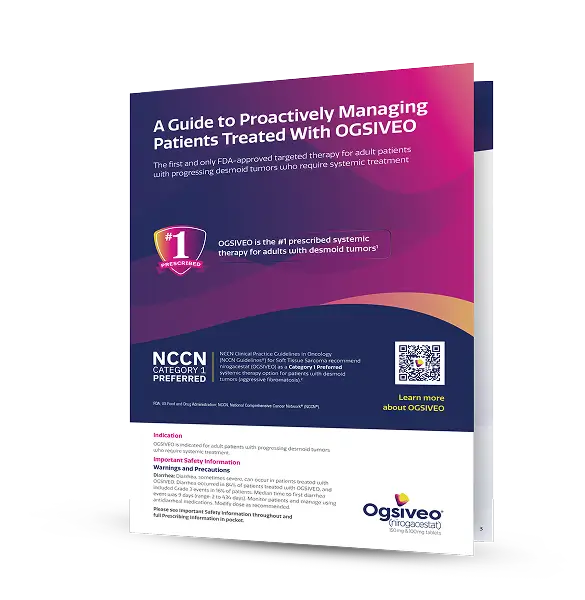
OGSIVEO® (nirogacestat) side effect management resource guide PDF

In the OGSIVEO trial, 95% of adverse events were Grade 1 or 2 and first onset for most patients occurred within 1 month of starting OGSIVEO1

Dosage modifications for adverse reactions

Support your patients by proactively managing side effects and using dose modifications as recommended.

Recommended dose modifications for adverse reactions2

Adverse Reaction
Severity
OGSIVEO Dosage Modifications
Diarrhea persisting for ≥3 days despite maximal medical therapy
Grades 3 or 4
Withhold OGSIVEO until resolved to Grade ≤1 or baseline, then restart at a dose of 100 mg twice daily.
ALT or AST increased
Grade 2
(≥3 to 5 x ULN)
Withhold OGSIVEO until ALT, AST, or both are resolved to <3 × ULN or baseline, then restart at a dose of 100 mg twice daily.
Grades 3 or 4 (>5 x ULN)
Permanently discontinue.
Hypophosphatemia persisting for ≥3 days despite maximal replacement therapy
Grades 3 or 4
Withhold OGSIVEO until resolved to Grade ≤1 or baseline, then restart at a dose of 100 mg twice daily.
Hypokalemia despite maximal replacement therapy

For other severe adverse reactions, life-threatening adverse reactions, or persistent intolerable Grade 2 adverse events, withhold drug until resolved to Grade ≤1 or baseline. Only restart at a dose of 100 mg twice daily after considering the potential benefit and likelihood of recurrence of the adverse reaction. Permanently discontinue OGSIVEO for recurrence of severe or life-threatening adverse reaction upon rechallenge at the reduced dose.

In patients who received OGSIVEO in the DeFi trial:

42% had dose reductions due to an adverse reaction2,*

51% had dose interruptions (median days interrupted per interruption: 8 days; range: 1 to 132 days) and 20% permanently discontinued due to an adverse reaction.2,3*

Adverse reactions that led to dose reduction, interruption, or discontinuation of OGSIVEO included: diarrhea, ovarian toxicity, increased ALT/AST, rash, stomatitis, hypophosphatemia, fatigue, folliculitis, nausea, and hidradenitis.2

For patients who were dose-reduced from 150 mg BID to 100 mg BID, no notable differences in PFS or ORR were observed3

Analysis Limitations
  • Based on a post-hoc analysis comparing PFS and ORR in patients treated with OGSIVEO in the DeFi study who dose-reduced versus those who did not
  • DeFi was not powered to assess statistical differences between subgroups and this analysis should be considered descriptive only
  • Therefore, the results require cautious interpretation and could represent chance findings
  • These data are not included in the OGSIVEO Prescribing Information

Medical interventions and lifestyle changes may also help manage certain side effects.

ALT, alanine aminotransferase; AST, aspartate aminotransferase; BID, twice daily; DeFi, Desmoid Fibromatosis; ORR, objective response rate; PFS, progression-free survival.

Patient Profiles

Review hypothetical patient profiles to learn about treatment considerations for different patient types. Setting expectations at treatment initiation, including discussing the most common adverse reactions with OGSIVEO and potential dose modifications may help patients stay on track with therapy.

Resources

Find information and resources to support your desmoid tumor patients, from diagnosis through treatment with OGSIVEO.

SpringWorks CareConnections® HCP Brochure

Learn about the SpringWorks CareConnections patient support program that provides personalized support to help your patients get started and stay on track with OGSIVEO.

close
Resources
Indication
Important Safety Information

Indication 

OGSIVEO is indicated for adult patients with progressing desmoid tumors who require systemic treatment.

Important Safety Information

Warnings And Precautions

Diarrhea: Diarrhea, sometimes severe, can occur in patients treated with OGSIVEO. Diarrhea occurred in 84% of patients treated with OGSIVEO, and included Grade 3 events in 16% of patients. Median time to first diarrhea event was 9 days (range: 2 to 434 days). Monitor patients and manage using antidiarrheal medications. Modify dose as recommended.

Ovarian Toxicity: Female reproductive function and fertility may be impaired in patients treated with OGSIVEO. Impact on fertility may depend on factors like duration of therapy and state of gonadal function at time of treatment. Long-term effects of OGSIVEO on fertility have not been established. Advise patients on the potential risks for ovarian toxicity before initiating treatment. Monitor patients for changes in menstrual cycle regularity or the development of symptoms of estrogen deficiency, including hot flashes, night sweats, and vaginal dryness.

Hepatotoxicity: ALT or AST elevations occurred in 30% and 33% of patients, respectively. Grade 3 ALT or AST elevations (>5 x ULN) occurred in 6% and 2.9% of patients. Monitor liver function tests regularly and modify dose as recommended.

Non-Melanoma Skin Cancers: New cutaneous squamous cell carcinoma and basal cell carcinoma occurred in 2.9% and 1.4% of patients, respectively. Perform dermatologic evaluations prior to initiation of OGSIVEO and routinely during treatment.

Electrolyte Abnormalities: Decreased phosphate (65%) and potassium (22%) occurred in OGSIVEO-treated patients. Phosphate <2 mg/dL occurred in 20% of patients. Grade 3 decreased potassium occurred in 1.4% of patients. Monitor phosphate and potassium levels regularly and supplement as necessary. Modify dose as recommended.

Embryo-Fetal Toxicity: OGSIVEO can cause fetal harm when administered to pregnant women. Oral administration of nirogacestat to pregnant rats during the period of organogenesis resulted in embryo-fetal toxicity and death at maternal exposures below human exposure at the recommended dose of 150 mg twice daily. Advise pregnant women of the potential risk to a fetus. Advise females and males of reproductive potential to use effective contraception during treatment with OGSIVEO and for 1 week after the last dose.

Adverse Reactions

The most common (≥15%) adverse reactions were diarrhea (84%), ovarian toxicity (75% in the 36 females of reproductive potential), rash (68%), nausea (54%), fatigue (54%), stomatitis (39%), headache (30%), abdominal pain (22%), cough (20%), alopecia (19%), upper respiratory tract infection (17%), and dyspnea (16%).

Serious adverse reactions occurred in 20% of patients who received OGSIVEO. Serious adverse reactions occurring in ≥2% of patients were ovarian toxicity (4%).

The most common laboratory abnormalities (≥15%) were decreased phosphate, increased urine glucose, increased urine protein, increased AST, increased ALT, and decreased potassium.

Drug Interactions

CYP3A Inhibitors and Inducers: Avoid concomitant use with strong or moderate CYP3A inhibitors (including grapefruit products, Seville oranges, and starfruit) and strong or moderate CYP3A inducers.

Gastric Acid Reducing Agents: Avoid concomitant use with proton pump inhibitors and H2 blockers. If concomitant use cannot be avoided, OGSIVEO can be staggered with antacids (e.g., administer OGSIVEO 2 hours before or 2 hours after antacid use).

Consult the full Prescribing Information prior to and during treatment for important drug interactions.

Use in Specific Populations

Because of the potential for serious adverse reactions in breastfed children, advise women not to breastfeed during treatment with OGSIVEO and for 1 week after the last dose.

Please click here for full Prescribing Information.

Indication 

OGSIVEO is indicated for adult patients with progressing desmoid tumors who require systemic treatment.

Please click here for full Prescribing Information.

References
  1. Gounder M, Ratan R, Alcindor T, et al. Nirogacestat, a gamma-secretase inhibitor for desmoid tumors. N Engl J Med. 2023;388(10):898-912.
  2. OGSIVEO. Prescribing Information. SpringWorks Therapeutics, Inc.
  3. Data on file. SpringWorks Therapeutics, Inc.