
Starting OGSIVEO
Get answers to your questions about starting OGSIVEO, plus tips for managing life on treatment.
Starting the conversation with your care team
Understanding what you may expect with OGSIVEO can help you navigate your treatment journey. Maintain open communication with your care team so they can help support you during your treatment journey.

When starting OGSIVEO, here are 3 questions that can help get the conversation started:
- What might I expect if I start taking OGSIVEO?
- How will you and the care team monitor my treatment with OGSIVEO?
- What should I do if I experience side effects?
Tell your care team if you think you may be experiencing side effects while taking OGSIVEO.
What to Expect on Treatment With Dr. Viveiros
Join Dr. Pedro Viveiros, a medical oncologist, as he explains the results from the OGSIVEO clinical trial and discusses what patients may expect when taking OGSIVEO.
“Let’s review the results of the OGSIVEO clinical study and OGSIVEO’s effect on tumor size and patient-reported pain levels.”
Dr. Pedro A. Hermida de Viveiros, MD, Assistant Professor, Medicine (Hematology and Oncology)
Northwestern University Feinberg School of Medicine
Before starting OGSIVEO
There are a few topics you should discuss with your doctor before taking OGSIVEO.2
All the medicines you take
including prescription and over-the-counter medicines, vitamins, and herbal supplements.
All of your medical conditions
including if you have liver problems.
If you are pregnant or plan to become pregnant
OGSIVEO can harm your unborn baby. Tell your healthcare provider if you become pregnant or think you may be pregnant during treatment with OGSIVEO.
If you are breastfeeding or plan to breastfeed, it is not known if OGSIVEO passes into your breast milk. Do not breastfeed during treatment with OGSIVEO and for 1 week after the last dose.2
Females who are able to become pregnant:2
- Your healthcare provider will give you a pregnancy test before you start treatment with OGSIVEO
- Use effective birth control (contraception) during treatment with OGSIVEO and for 1 week after the last dose. If you use a birth control method that contains hormones (for example, birth control pills, injections, or transdermal system patches), an additional barrier method of contraception (for example, diaphragm or condom) is recommended. Birth control methods that contain hormones may not work as well during treatment with OGSIVEO
- Talk to your healthcare provider about birth control methods that may be right for you
- Stop taking OGSIVEO and tell your healthcare provider right away if you become pregnant
Males with female partners who are able to become pregnant:2
- Use effective birth control (contraception) during treatment with OGSIVEO and for 1 week after the last dose

Ready to learn more? Download the OGSIVEO Digital Resource Kit to get:
Taking OGSIVEO
OGSIVEO is a convenient oral medicine you can take at home.2
OGSIVEO can be taken with or without food2
Swallow OGSIVEO tablets whole. Do not break, crush, or chew2
Avoid eating or drinking grapefruit products, Seville oranges, and starfruit during treatment with OGSIVEO2
If you take an antacid medicine, take OGSIVEO 2 hours before or 2 hours after taking the antacid2
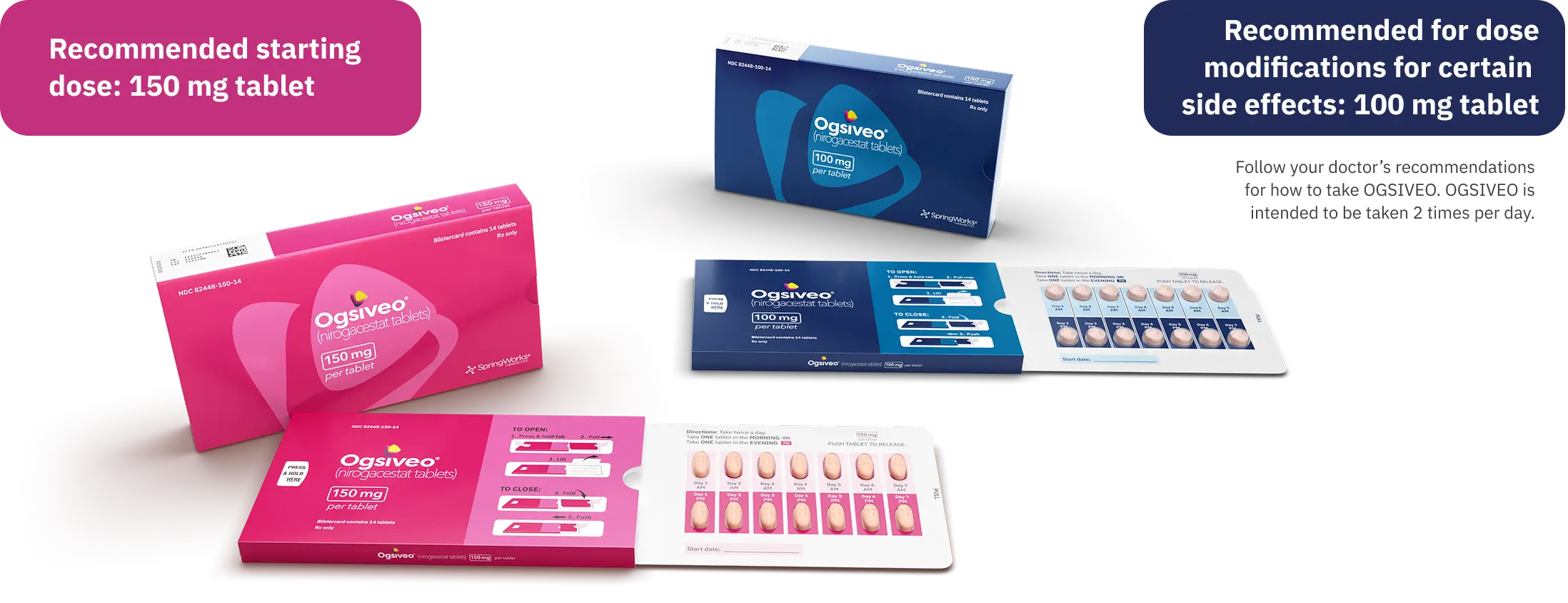
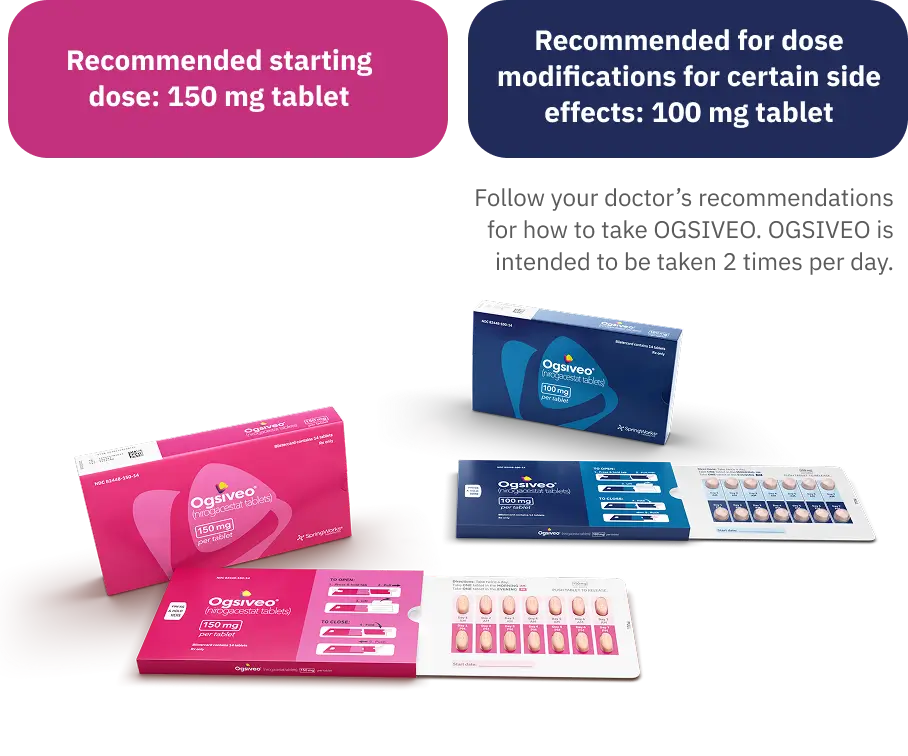
Tablets shown are not actual size. See blister pack for opening and use instructions. The images shown are for illustration only and may not be an exact representation of the product.
OGSIVEO blister packs may help you track your dose more easily with clear AM/PM dosing by day of the week
- Each blister pack contains a 7-day supply
- Four blister packs provide a 28-day supply
Keeping in touch with your care team
Everyone responds to medication differently. If you think you may be experiencing side effects, talk to your care team.
Your doctor may change your dose, temporarily stop, or permanently stop treatment with OGSIVEO if you develop side effects.2
Staying on track with your treatment
Remember to attend your follow-up appointments and to take your medication as recommended by your care team.
Following your dosing schedule and getting medication refilled as needed can help you stay on track with your treatment.
You can use apps or trackers such as the OGSIVEO Digital Companion to help log changes in your desmoid tumor symptoms or potential side effects during treatment.

I have my routine down with OGSIVEO. I take it first thing in the morning and last thing before I go to bed, and I don’t have to worry about taking it with food or with milk. It’s just twice a day.
Watch Christina’s full story and hear other patient voices.
Individual results may vary.
Frequently asked questions about starting OGSIVEO
How should I take OGSIVEO?
OGSIVEO is an oral medicine you can take with or without food.2
OGSIVEO comes in 150 mg and 100 mg tablets2
- The recommended dosage of OGSIVEO is 150 mg taken 2 times a day. The recommended dose modification for certain side effects is 100 mg taken 2 times per day
- Take OGSIVEO exactly as your healthcare provider tells you to take it
- Swallow OGSIVEO tablets whole. Do not break, crush, or chew
- If you take an antacid medicine, take OGSIVEO 2 hours before or 2 hours after taking the antacid
- Tell your doctor about all the medicines you take—including prescription and over-the-counter medicines, vitamins, and herbal supplements
What if I vomit or miss a dose?
If you vomit after taking a dose or miss a dose of OGSIVEO, take your next dose at the regular time. Do not take 2 doses of OGSIVEO to make up the dose.2
What should I avoid when taking OGSIVEO?
Certain foods or medicines may cause a change in the way OGSIVEO acts in the body. Avoid eating or drinking grapefruit products, Seville oranges, and starfruit during treatment with OGSIVEO.2
Proton pump inhibitors (PPIs), H2 blockers, and antacids are different types of medicines that affect stomach acid. They may be available over-the-counter or with a prescription.3-5
Avoid taking proton pump inhibitors (PPIs) or H2 blockers during treatment with OGSIVEO.2
- PPIs and H2 blockers reduce the amount of stomach acid made by the cells lining the stomach3,4
- PPIs and H2 blockers may be used for acid reflux or a stomach ulcer3,4
- Omeprazole (Prilosec®), lansoprazole (Prevacid®), and esomeprazole (Nexium®) are examples of PPIs
- Cimetidine (Tagamet HB®), famotidine (Pepcid®), and nizatidine (Axid®) are examples of H2 blockers
If you take an antacid medicine, OGSIVEO should be taken 2 hours before or 2 hours after taking the antacid.2
- Antacids work by neutralizing stomach acid to help treat heartburn and indigestion5,6
- Tums®, Rolaids®, and Mylanta® are examples of antacids
Ask your healthcare provider if you are not sure if you take one of these medicines.
How long will I take OGSIVEO?
Talk to your doctors about how long you might take OGSIVEO. In general, you will keep taking OGSIVEO unless your tumor grows (progresses), your symptoms worsen, or you have troublesome side effects that cannot be managed, as determined with your doctor.
During the clinical trial, people took OGSIVEO for a time period ranging from less than 1 month to over 2.5 years.2
How do I store OGSIVEO?
Store OGSIVEO tablets at room temperature between 68°F to 77°F (20°C to 25°C). Keep OGSIVEO and all medicines out of reach of children.
Tell your doctor about all the medicines you take–including prescription and over-the-counter medicines, vitamins, and herbal supplements2
Be your own health advocate by keeping track of your symptoms and side effects
Documenting the frequency and severity of your symptoms and possible side effects can help your care team support you during treatment.
- Download our Treatment Tracker to log changes to your desmoid tumor symptoms as well as potential side effects you may experience during treatment
- Or, go digital with the OGSIVEO Digital Companion—available for free through the Medisafe app*
Medisafe is a third party independent of SpringWorks and SpringWorks has no control over the Medisafe app. The Medisafe app and OGSIVEO Digital Companion have different terms of use and privacy policies. Please refer to those applications for the applicable terms of use and privacy policies.
What are the possible side effects of OGSIVEO?
OGSIVEO can cause serious side effects, including:1
Diarrhea
Diarrhea is common during treatment with OGSIVEO, and may sometimes be severe. Your healthcare provider may tell you to drink more fluids, or may tell you to take antidiarrheal medicines. Tell your healthcare provider right away if you have diarrhea that lasts longer than a few days and does not get better after taking antidiarrheal medicines.
Ovarian Problems
Females who are able to become pregnant may have ovarian problems and changes in their menstrual cycle during treatment with OGSIVEO. OGSIVEO may affect fertility which may affect your ability to have a child. Tell your healthcare provider if you have any changes in your menstrual cycle or any hot flashes, night sweats, or vaginal dryness during treatment with OGSIVEO.
Liver problems
OGSIVEO can cause an increase in liver enzymes. Your healthcare provider will do blood tests to check your liver function before you start and during your treatment with OGSIVEO.
New non-melanoma skin cancers
Your healthcare provider will do skin exams before and during treatment with OGSIVEO if you are at risk for skin cancer. Tell your healthcare provider if you have any new or changing skin lesions.
Electrolyte (salt) problems
Your healthcare provider will do blood tests to check your phosphate and potassium levels during treatment with OGSIVEO and may give you medicines to treat low phosphate or low potassium if needed. Tell your healthcare provider if you develop any muscle pain or weakness.
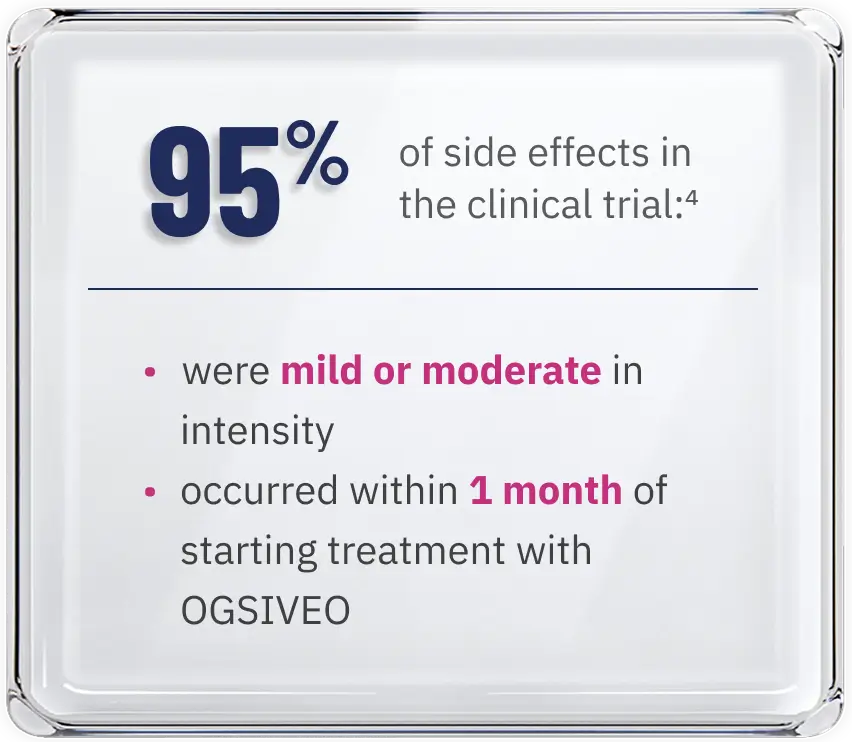
of side effects in the clinical trial:4
- were mild or moderate in intensity
- occurred within 1 month of starting treatment with OGSIVEO
The Most Common Side Effects of OGSIVEO include:1
- Diarrhea
- Ovarian problems
- Rash
- Nausea
- Tiredness
- Mouth sores
- Headache
- Stomach (abdominal) pain
- Cough
- Hair loss
- Upper respiratory infection
- Shortness of breath
These are not all of the possible side effects of OGSIVEO. Call your doctor for medical advice about side effects. You are encouraged to report negative side effects or quality complaints of prescription drugs to the FDA. Visit www.fda.gov/medwatch or 1-800-FDA-1088
OGSIVEO may affect fertility in females and males, which may affect your ability to have a child. Talk to your healthcare provider if this is a concern for you.2
If you think you may be experiencing any side effects, call your healthcare provider. Your healthcare provider may recommend medications or other approaches to help you manage side effects.
Your healthcare provider may change your dose, temporarily stop, or permanently stop treatment with OGSIVEO.
Always follow your doctor’s recommendations.
I did develop a full body rash and so my medical teams’ response was to take me off medication, give me a break, and shortly thereafter my rash completely resolved. After three weeks, I went back on the medication again at a reduced dose and I did not have any recurrence of the rash.
Watch Dana’s full story, and hear other patient voices.
Individual results may vary.

Managing Side Effects
Tell your care team about any side effects you experience while taking OGSIVEO.2 Side effects can start within the first month of taking OGSIVEO.7 There might be supportive medicines, therapies, or dietary adjustments that your doctor or care team can recommend for certain side effects to help during treatment. Let them know what you experience. Your doctor may recommend pausing treatment until side effects subside. Your doctor may also determine if a lower dose or stopping treatment is right for you. Always follow your doctor’s recommendations. Keep track of your symptoms and talk to your doctor if you think you may be experiencing potential side effects.
The recommended starting dose of OGSIVEO is 150 mg twice daily.2
Your doctor may reduce your dose to 100 mg twice a day if you have certain side effects.2
- In the approval study, 42% of patients taking OGSIVEO in the clinical trial had their dose reduced because of certain side effects2,*
- Patients taking OGSIVEO in the clinical trial who experienced improvements in progression-free survival and objective response included patients taking OGSIVEO 150 mg twice daily and patients whose dose was reduced to 100 mg twice daily2
If you experience side effects while using OGSIVEO, talk to your doctor. Your doctor will determine if a change such as a lower dose, a pause, or stopping treatment is right for you.
Side effects that led to a dose reduction included: diarrhea, rash, mouth sores, electrolyte (salt) problems, serious skin conditions, and ovarian problems.
Thinking about talking to your doctor?
Prepare ahead with our Discussion Guide.
Frequently asked questions about side effects
What should I do if I think I am having side effects?
Side effects can start within the first month of taking OGSIVEO.7 There might be therapies or other approaches that your doctor or care team can recommend for certain side effects to help during treatment.
Let them know what you experience. Your doctor may recommend pausing treatment until side effects subside. Your doctor may also determine if a lower dose or stopping treatment is right for you. Always follow your doctor’s recommendations.
Will OGSIVEO affect my menstrual cycle?
Females who are able to become pregnant may have ovarian problems and changes in their menstrual cycle (including irregular periods or no periods) during treatment with OGSIVEO. Symptoms such as hot flashes, night sweats, or vaginal dryness are common in females of reproductive potential treated with OGSIVEO.2
Talk to your doctor if you have any questions about what to expect during treatment with OGSIVEO.
Can diarrhea be managed while taking OGSIVEO?
Diarrhea is a common side effect of OGSIVEO and may sometimes be severe. Your doctor may recommend an over-the-counter anti-diarrheal medication or other strategies to manage it. Loperamide is an example of an anti-diarrheal medication. Let your doctor know right away if you have diarrhea that lasts longer than a few days and does not get better after taking antidiarrheal medicines.2
Staying hydrated can help. Drink plenty of fluids throughout the day. You may also find it easier to eat smaller meals more often instead of large ones. Consider choosing bland foods and avoiding foods that may cause stomach upset, such as caffeine, alcohol, dairy, and spicy, fatty, or greasy foods.9,10
Keeping track of your bowel movements can be helpful for your doctor. This includes how often you go, the consistency of your stools, and any discomfort you experience.9,10
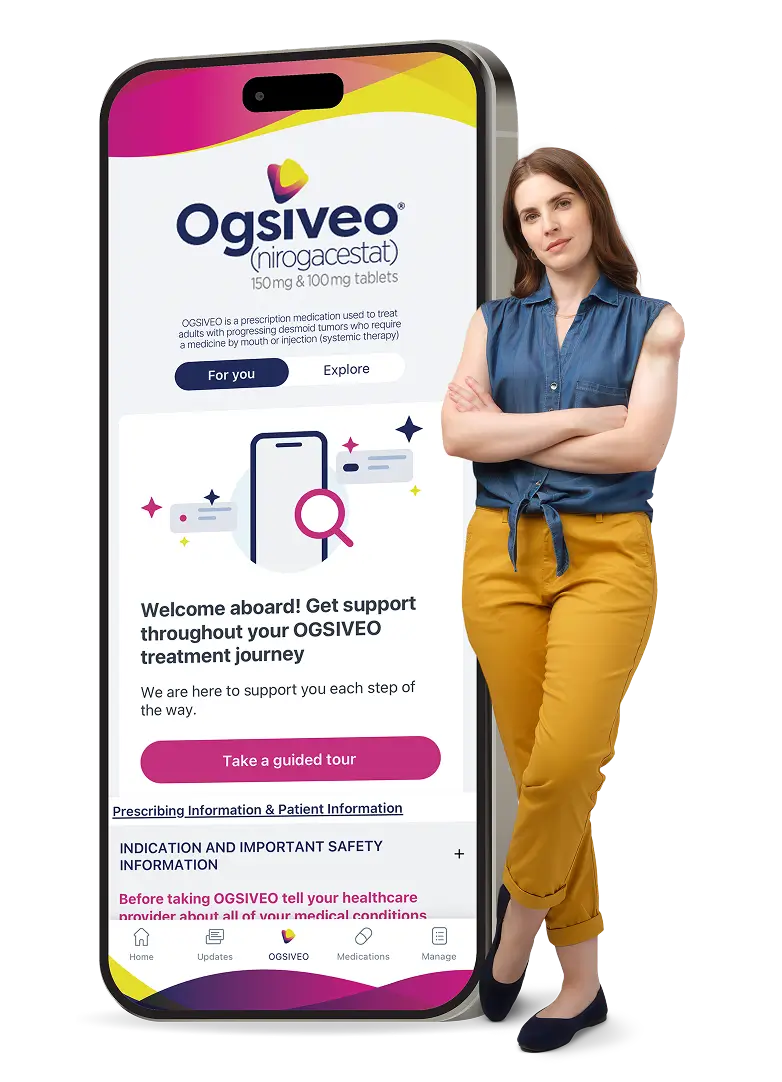
The OGSIVEO Digital Companion can help you stay on track during your treatment journey
The OGSIVEO Digital Companion, available on the free Medisafe app, helps you:
- Get reminders for your scheduled doses and refills
- Log symptoms and potential side effects, and upload photos or scans of your desmoid tumor, which can help you have more productive conversations with your care team
- Find OGSIVEO information, tips, and resources conveniently within the app
- Manage your doctor’s appointments and medications—including OGSIVEO—in one place
- Share your information with your family or care partners
Plus, patients who are enrolled in SpringWorks CareConnections® can connect with their Nurse Advocate directly through the app.
Medisafe is available for iOS and Android.

Sign up for information & resources
Sign up for information, tips, and resources to help you talk to your doctor as you navigate your treatment journey.