
Living With Desmoid Tumors
Learn about desmoid tumors and find links to advocacy groups.
Facts & Stats on Desmoid Tumors
Explore the following information about desmoid tumors to help make informed decisions with your care team.
Desmoid tumors are dense, soft tissue tumors. They can grow aggressively and affect nearby tissues and organs. A desmoid tumor is also called aggressive fibromatosis. Only 3% of soft tissue tumors are desmoid tumors. It is a rare tumor type.1-3
In the US, up to 1650 people are diagnosed with desmoid tumors every year.4-6
Women are more likely to be diagnosed with desmoid tumors, but men are at risk as well5,7,8
The majority of people with desmoid tumors are diagnosed in young adulthood5
After surgery, desmoid tumors may come back—based on the tumor location and other factors8,9
Desmoid tumors can affect each person differently depending on where the tumor is in the body, how fast it grows, and other factors.
The risk of desmoid tumors rises for people with a family history of familial adenomatous polyposis (FAP).10 If a person has FAP, doctors may recommend a colectomy to help prevent colon cancer. However, for some, this surgery can increase the risk of developing desmoid tumors.3
Desmoid tumors can develop anywhere in the body where there is soft connective tissue.1 For example: tumors may form in tissues inside the abdomen (intra-abdominal), the chest, legs and feet, arms and hands, or the head and neck.3
Desmoid tumors do not spread to other parts of the body (metastasize). Although they are not malignant, they can cause serious health problems as they grow. They can affect and damage surrounding organs, blood vessels, and nerves.1
Desmoid tumor symptoms can vary based on where the tumor is located
A tumor within the abdominal area may cause digestive system blockages, pain, malaise, abdominal swelling, weight loss, or muscle wasting.3,11,12
Tumors in the arms or legs may cause limited movement, deformity, pain, tiredness, weakness, or muscle problems.3,13,14
Identifying Progression
It’s important to know if your tumor is progressing, or getting worse.15 The NCCN* Guidelines for Patients® suggest starting treatment for desmoid tumors if:16
You’re experiencing symptoms

This tumor is affecting how you function
Scans show the tumor is growing
The National Comprehensive Cancer Network® (NCCN®) is a not-for-profit alliance of leading cancer centers devoted to patient care, research, and education.
I went from doctor to doctor and specialist to specialist trying to find someone who could give me answers.
Watch Christina’s full story and hear other patient voices.
Individual results may vary.

Regularly monitoring and reporting your symptoms to your healthcare providers can help them to create a more personalized treatment plan
- Listen to your body. New or changing symptoms, such as new lumps you can see or feel, or increased pain, could signal progression and may indicate it’s time to discuss a treatment adjustment2,15
- Keep track of your symptoms. Track your symptoms with helpful tools like the OGSIVEO Treatment Tracker
- Don’t delay. Don’t wait to talk to your doctor, advocate for yourself, and don’t miss your regular scans
Digital symptom trackers are also available
The OGSIVEO Digital Companion on the Medisafe app has features for logging desmoid tumor symptoms and allows you to get reminders for medications and doctor’s appointments to help you stay on track with your treatment.
There are also various health apps you can use to keep track of your symptoms on your smartphone such as Apple Health™. WebMD® also offers a tracking feature called Symptom Checker.

These applications are provided for informational purposes only and do not represent an endorsement or a recommendation from SpringWorks Therapeutics, Inc. The applications listed are independent of SpringWorks and SpringWorks has no control over the content of these applications. The applications are linked to other websites that have different terms of use and privacy policies. Please refer to those applications and websites for the applicable terms of use and privacy policies.
Guideline Recommendation
The NCCN Guidelines for Patients recommend systemic therapy as a preferred treatment option for desmoid tumors that are growing and/or causing symptoms.16
Nirogacestat (OGSIVEO) is recommended by the NCCN Guidelines for Patients as a treatment option for desmoid tumors that are growing and/or causing symptoms.16
The National Comprehensive Cancer Network (NCCN) is a not-for-profit alliance of leading cancer centers devoted to patient care, research and education.
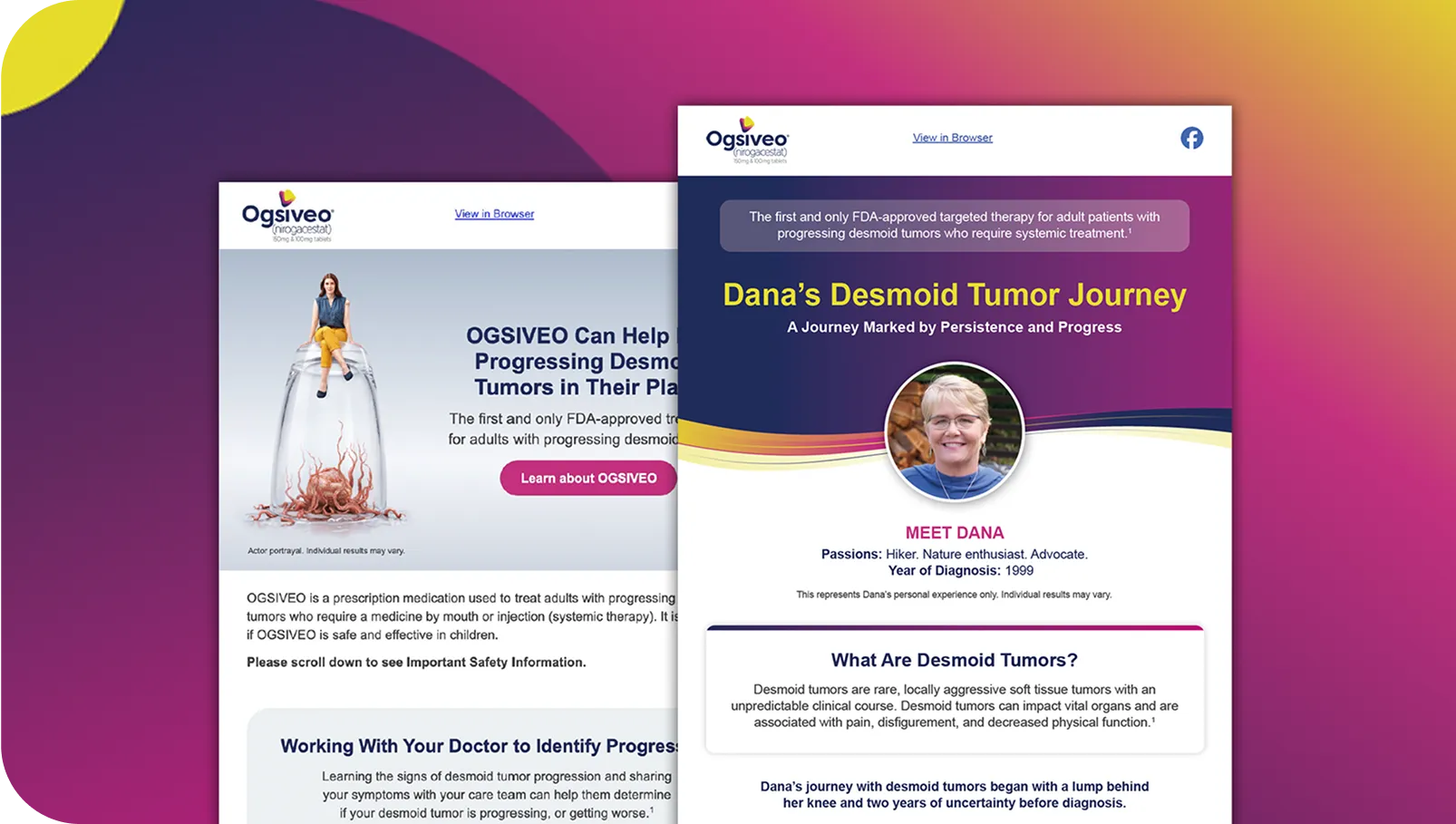
Stay informed with OGSIVEO emails
Sign up for information and resources designed to help you understand your options and have productive conversations with your care team throughout your treatment journey.
Frequently Asked Questions
How are desmoid tumors diagnosed?
Your doctor may perform a physical exam and ask about your medical and family history.
These tests can also help with diagnosis:
- Biopsy: Typically, a tiny sample of the tumor tissue is taken out with a needle and analyzed by a pathologist to confirm if it is a desmoid tumor16,17
- Imaging Scans (CT or MRI16,17 ) can also help your doctor see the location and size of the tumor
Can desmoid tumors be mistaken for other conditions?
Because they are so rare, desmoid tumors may sometimes be misdiagnosed as:7,18
- Hypertrophic scars or keloids
- Low-grade sarcomas or gastrointestinal stromal tumor (GIST)
- Benign growths such as nodular fasciitis, lipoma, fibroma, schwannoma, or leiomyoma
Where can I learn more about desmoid tumors?
You may ask your doctor or care team for additional information. Explore online resources through advocacy groups and communities focused on desmoid tumor education, including:
- The Desmoid Tumor Research Foundation (DTRF)
- The Desmoid Project
- Rein In Sarcoma
- Sarcoma Alliance for Research through Collaboration (SARC)
- Northwest Sarcoma Foundation
- Sarcoma Foundation of America (SFA)
- Sarcoma Strong Inc.
- National Organization for Rare Disorders (NORD)
- Global Genes
For more information, the National Comprehensive Cancer Network® (NCCN®) also has helpful resources, including the NCCN Guidelines for Patients®: Soft Tissue Sarcoma.
SpringWorks Therapeutics, Inc. is providing these links to help patients find more information about desmoid tumors, but inclusion on this list does not represent an endorsement or a recommendation from SpringWorks for any group or organization. The organizations listed are independent of SpringWorks Therapeutics.
Which healthcare professionals can help with treating or managing desmoid tumors?
Your care team may include desmoid tumor specialists, such as:16,19
- Medical oncologist
- Surgeon, orthopedic or surgical oncologist
- Radiation oncologist
- Pathologist
Your care team may also include nurses, nurse practitioners, and physician assistants.
Mental health and other healthcare professionals may also be involved in your care.19
If a local desmoid tumor specialist isn’t available, they may still be able to collaborate with a local community oncologist to manage your care closer to home.16
A multidisciplinary care team can help you:20
- Decide on your individualized care plan based on the advice of multiple healthcare professionals, including a desmoid tumor specialist or expert
- Coordinate your care for a faster time to treatment
- Use the team’s shared knowledge to help make informed treatment decisions

Advocacy Groups
The following advocacy organizations can provide additional support and information for patients with desmoid tumors







The organizations listed are independent of SpringWorks Therapeutics. SpringWorks Therapeutics, Inc. is providing these links to help patients find more information about desmoid tumors, but inclusion on this list does not represent an endorsement or a recommendation from SpringWorks Therapeutics for any group or organization. Logos are used with permission.
Glossary

Sign up for information & resources
Sign up for information, tips, and resources to help you talk to your doctor as you navigate your treatment journey.